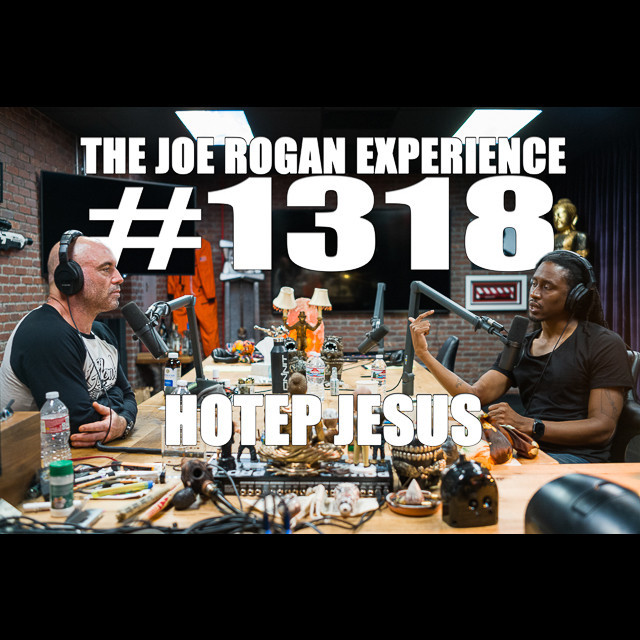
26-Jun-19
#1318 – Hotep Jesus
This podcast delves into the complexities of free speech, online censorship, and the evolving nature of social media platforms. Hotep Jesus, a tech investor, marketer, and author, shares his perspective on how these platforms are shaping public discourse, and the role of influencers in navigating this landscape. Controversial topics like the influence of social media algorithms, the potential for manipulation, and the rise of “soy boys” are discussed, leading to engaging and thought-provoking discussions about societal trends and individual responsibility.
Major Topics:
- The Power of Social Media Algorithms:
- Social media algorithms are not neutral and can influence content visibility and user engagement.
- Platforms like Facebook and YouTube are not simply neutral platforms, but actively shape content consumption through algorithms.
- The algorithm can favor controversial content to drive engagement, which can lead to the spread of misinformation and polarization.
- The implications for free speech and the control of information are significant, raising questions about the role of technology in shaping public opinion.
- Online Censorship and the “Trust and Safety” Board:
- The “Trust and Safety” board, tasked with regulating content on platforms like Twitter, is seen as biased, with a lack of representation for conservative viewpoints.
- The board’s decisions can limit free speech and stifle dissenting opinions, raising concerns about the potential for censorship and manipulation.
- The podcast highlights the importance of diverse representation on these boards to ensure a balanced and fair approach to content moderation.
- The discussion explores the tension between free speech and the need to protect against harmful content, highlighting the complexities of online regulation.
- The Rise of Alternative Platforms and the Search for Decentralization:
- The dominance of large tech companies like Google, Facebook, and Twitter has created a need for alternative platforms to offer greater freedom of expression.
- Hotep Jesus argues that while these platforms may not reach the same scale as their mainstream counterparts, they offer valuable options for users seeking greater autonomy.
- The podcast emphasizes the importance of building independent platforms and diversifying content creation to challenge the dominance of centralized platforms.
- The discussion explores the potential for blockchain technology to create more decentralized and user-owned online spaces.
- The Influence of Advertisers and the Monetization of Content:
- Advertisers exert significant influence on social media platforms, dictating what content is considered “advertiser-friendly” and what is demonetized.
- This can lead to self-censorship by creators, who fear losing revenue if they produce content deemed too controversial or sensitive.
- The monetization of content creates a complex dynamic, where creators are incentivized to prioritize advertiser interests over their own values.
- The podcast raises questions about the future of online content creation in an environment where advertiser influence is paramount.
- The “Soy Boy” Phenomenon and the Degradation of Masculinity:
- The concept of the “soy boy” is explored as a critique of perceived cultural trends toward effeminate masculinity and a decline in traditional values.
- The podcast delves into the role of soy consumption, perceived as an endocrine disruptor, and its potential impact on male hormone levels.
- The discussion examines the broader societal implications of this perceived trend, including its impact on relationships and social dynamics.
- Hotep Jesus advocates for a return to traditional masculine values, emphasizing the importance of discipline, self-control, and responsibility.
- The Importance of Self-Discipline and Personal Responsibility:
- The podcast highlights the importance of individual responsibility and self-discipline, particularly in navigating the complexities of social media and societal pressures.
- Hotep Jesus stresses the need for critical thinking, skepticism, and the ability to discern truth from misinformation in an age of overwhelming information.
- He emphasizes the importance of developing a strong sense of self and purpose, independent of external validation or societal expectations.
- The discussion explores the role of personal responsibility in shaping one’s own destiny and navigating the challenges of modern life.
- The Value of Knowledge and Education:
- Hotep Jesus emphasizes the importance of education and continuous learning as fundamental to personal growth and success.
- He advocates for a wide-ranging approach to knowledge acquisition, encompassing history, philosophy, science, and personal experiences.
- The discussion highlights the role of education in empowering individuals to make informed decisions and challenge prevailing narratives.
- The podcast encourages listeners to prioritize lifelong learning and to actively seek out diverse perspectives and information.
- The Power of Intention and Manifestation:
- Hotep Jesus explores the concept of intention and manifestation, arguing that a combination of focused thought, action, and belief can shape reality.
- He shares personal anecdotes illustrating how intention and a willingness to take action have led to unexpected opportunities and success.
- The podcast encourages listeners to embrace the power of their own thoughts and to actively create the life they desire.
- The discussion touches on the potential for both positive and negative manifestations, emphasizing the importance of aligning intentions with ethical principles.
- The Importance of Spiritual Development:
- The podcast explores the importance of spiritual development, connecting it to self-awareness, purpose, and a deeper understanding of life’s complexities.
- Hotep Jesus encourages listeners to connect with their “astro body,” a concept he describes as an ethereal version of the physical body that can access higher knowledge and intuition.
- He draws parallels between spiritual practices and the scientific understanding of the subconscious mind, suggesting that both can play a role in shaping reality.
- The discussion challenges listeners to explore their own spiritual paths and to embrace the potential for personal transformation.
- The Revisionist History of Slavery and the African Diaspora:
- Hotep Jesus challenges conventional narratives about the African diaspora and slavery, arguing that a significant population of Africans may have already been present in North and South America before European colonization.
- He cites evidence from archaeology, ocean currents, and historical accounts to support this claim, suggesting that Africans were not solely victims of the transatlantic slave trade.
- The podcast explores the potential for a more nuanced and complex understanding of African history and the role of Africans in shaping the Americas.
- This discussion raises questions about the biases in historical narratives and the need for a more inclusive and accurate understanding of the past.
- The Need for Objectivity in Social and Political Discussions:
- The podcast emphasizes the importance of objectivity in social and political discussions, urging listeners to challenge biased narratives and to seek out diverse perspectives.
- Hotep Jesus argues against the use of labels like “racist” or “sexist” as silencing tactics, instead advocating for open dialogue and a willingness to engage with differing viewpoints.
- He encourages listeners to engage with complex issues from a critical and analytical perspective, rather than relying on predetermined ideologies.
- The discussion highlights the need for intellectual honesty and open-mindedness in navigating the often divisive landscape of social and political discourse.
Memorable Quotes:
- “We’re kinda seeing that with Twitter. And we’re kind of seeing that with Facebook and with Google and they’re they’re deciding what could be heard and what not could be heard.”
- “If you’re killing a whole sub, well, it doesn’t depends. I mean Well So if there really that would be really interesting if it turns out that it was someone from the left that was posing as someone from the right in order to shut down a forum and pretend there’s death threats or I mean, you look at YouTube. Right? And what what’s been happening with YouTube, even just the algorithm. You know?”
- “I think the Internet was initially created to exchange information. And then when it got loose to the general public, they realized what a crazy idea that was.”
- “My thing is with, like, the Reddit thing. Right? It’s very easy to create an actor. Right? The left can create a right wing actor online. Pretend like it’s something about — Sure. — it’s something else. They can go in to Reddit, do something malicious to get the whole Reddit band. Right? Like an agent provides a tour. Yeah. Exactly. And I never leave that off the table when I look at it.”
- “I think sometimes we try to prune them too much.”