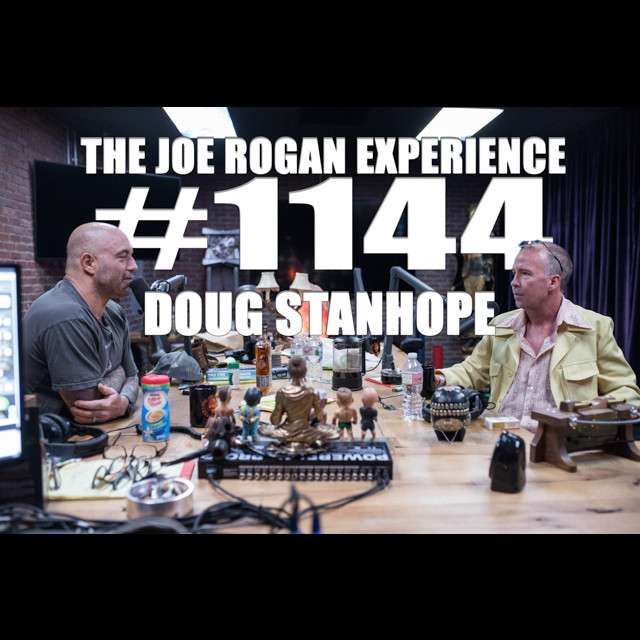
16-Jul-18
This podcast dives into the humorous and often controversial world of comedian Doug Stanhope, touching on topics ranging from his personal life in Bisbee, Arizona, to his thoughts on politics, social issues, and the nature of comedy itself. Provocative topics include his disdain for certain aspects of the political landscape, his experiences with “trolling” Ted Nugent, his views on gun control, and his controversial take on the MeToo movement. Underlying themes explore the value of personal responsibility, the absurdity of cancel culture, the complexities of human behavior, and the importance of finding balance in a chaotic world.
Major Podcast Topics
- Doug Stanhope’s Life in Bisbee, Arizona:
- Stanhope describes his move to Bisbee, a small town of 5,000 people, as a deliberate choice to escape the pressures of big-city life. He enjoys the peace and quiet and the sense of community.
- He discusses the town’s unique political divide, which centers around local issues rather than traditional conservative and liberal ideologies.
- He shares humorous anecdotes about the town’s eccentricities and the challenges of maintaining his privacy in a small community.
- Stanhope’s desire to find a balance between his need for solitude and his appreciation for human connection is evident in his choice to live in Bisbee.
- Trolling Ted Nugent’s Message Board:
- Stanhope recounts his past “trolling” of Ted Nugent’s message board, a time when he deliberately engaged in provocative and often insulting behavior to stir up controversy.
- He reveals that Nugent’s message board was a breeding ground for “MAGA” sentiment before the term became popular.
- He discusses the motivations behind his trolling, acknowledging that it was both a humorous experiment and a way to get a rise out of Nugent’s fans.
- This topic delves into the dynamics of internet culture, the role of “trolling” in shaping online discourse, and the potential for such behavior to influence real-world events.
- Gun Control and Violence:
- Stanhope delves into the complex and controversial topic of gun control, acknowledging the existence of a gun problem in America but arguing that the issue goes beyond the simple presence of guns.
- He discusses the role of human nature in perpetrating violence, suggesting that the root cause lies in a human problem rather than a gun problem.
- He challenges the idea that either side of the gun control debate has a clear solution, suggesting that the focus should be on addressing the underlying human behavior that fuels violence.
- This topic explores the ethical dilemmas surrounding gun control, the complexities of human behavior, and the difficulty in finding solutions to multifaceted societal problems.
- Overpopulation and Human Value:
- Stanhope and Rogan engage in a humorous and thought-provoking conversation about the potential impact of overpopulation on human values and social interactions.
- They suggest that the sheer number of people in crowded environments can lead to a diminished sense of individual value and an increase in apathy.
- Stanhope uses the analogy of a crowded apartment filled with kittens to illustrate how the abundance of something can devalue it, suggesting that this applies to human beings as well.
- This topic explores the philosophical implications of population density on human interaction, social structures, and the perceived value of individual lives.
- Cancel Culture and the Absurdity of Outrage:
- Stanhope and Rogan discuss the rise of “cancel culture,” a phenomenon where individuals are publicly ostracized or condemned for past actions or statements, often without context or opportunity for redemption.
- Stanhope criticizes the knee-jerk reactions and outrage culture that have become prevalent in social media, arguing that people often overreact to statements without understanding the intent or context.
- He uses the example of Roseanne Barr’s firing from her sitcom as a prime example of cancel culture, arguing that she was unfairly judged for a single tweet without taking into account her complex mental state and history of controversial statements.
- This topic delves into the evolving landscape of social media, the implications of online outrage on individual lives and careers, and the tension between accountability and forgiveness.
- The Drug War and its Consequences:
- Stanhope and Rogan debate the merits of legalizing drugs, arguing that the current prohibitionist policy has created more problems than it has solved.
- They suggest that the criminalization of drugs has fueled the rise of powerful cartels, violence, and a lack of regulation in the drug market.
- Stanhope proposes a “myth for mushrooms” exchange program as a humorous solution to drug-related crime and the societal problems associated with prohibition.
- This topic explores the complex and controversial issue of drug legalization, the unintended consequences of prohibition, and the potential benefits of a more regulated approach to drug use.
- The Nature of Comedy and its Evolution:
- Stanhope reflects on the changing nature of comedy and the challenges of navigating the current political and social landscape.
- He argues that “real comedy” sometimes requires offense and that comedians should not be afraid to push boundaries and explore controversial topics.
- He discusses the rise of “cancel culture” and its impact on comedy, suggesting that it creates a climate of fear and self-censorship.
- Stanhope’s own approach to comedy is characterized by a willingness to be provocative and confrontational, a style that has both endeared him to some and alienated others.
- The Importance of Personal Responsibility:
- Stanhope repeatedly emphasizes the importance of personal responsibility, suggesting that individuals should be accountable for their actions and choices.
- He criticizes the tendency to blame external factors or groups for personal failings, arguing that individuals have the power to shape their own lives and destinies.
- He uses examples like Jordan Peterson’s views on individual responsibility and the role of mental illness in Roseanne Barr’s controversial behavior to illustrate his point.
- This topic delves into the philosophical concepts of free will, agency, and the impact of individual choices on the course of one’s life.
- The Absurdity of Politics and the Power of Ego:
- Stanhope shares his cynical views on the political landscape, suggesting that politicians often prioritize their own agendas and personal gain over the needs of the people they represent.
- He discusses the role of ego in political decision-making, suggesting that politicians are often motivated by a desire for power, attention, and validation.
- He uses the example of Donald Trump to illustrate how a politician’s ego can drive their actions and influence their policies.
- This topic explores the complexities of political systems, the motivations of politicians, and the potential for ego to undermine the principles of good governance.
- The Importance of Finding Balance:
- Stanhope highlights the importance of finding balance in life, both personally and politically.
- He encourages listeners to avoid identifying with extreme ideologies or groups, suggesting that a more nuanced and open-minded approach to life is essential for navigating complex societal issues.
- He discusses the value of solitude and reflection, emphasizing the need for introspection and self-awareness in a world saturated with noise and distractions.
- This topic explores the philosophical concepts of moderation, equilibrium, and the search for meaning and purpose in a chaotic world.
5 Memorable Quotes
- “Stevia is an artificial sweetener. And it’s a big scam where he’s there’s no artificial sweeteners. Because you hate getting that fucking ascertain taste. Right. And then but then they have stevia in it because it’s natural, and it still tastes like shit. So you’re thinking, oh, good. It’s no artificial sweeteners. That means it’s not oh, it still tastes like shit. But it’s it’s natural shit.”
- “Most people are just having these half assed, half cocked, shitty thought out arguments about almost everything they talk about, including me. I mean, including especially on this podcast many many times. But this is something that we it’s standard. There’s too much shit to know.”
- “I think if Trump was any Republican that wasn’t an a a fucking asshole, but stood for the same principles. There would be no outrage. They hate his personality first, which I’m not against you. Yes. Yeah. He’s a fucking loser, but he’s the 1 you created.”
- “I don’t think most people are qualified to be cops. Think it’s a really fucking hard job, and I think the pressure of it fucks people up. Even if they did go into that job, if they gravitate towards it because they were bullies, which I’m sure a certain percentage do. Certain for I think for most of them, it’s just a good job, and they think they can pull it off.”
- “Live cheap. Discount mate lesson to you all, America. Live like ducks stand up or don’t.”