5/21/2018
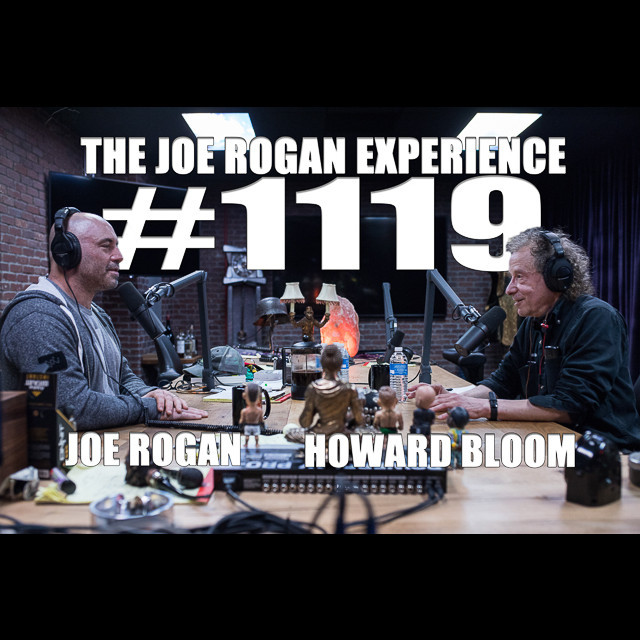
Podcast Topics: #1119 – Howard Bloom
This podcast dives into the fascinating life and mind of Howard Bloom, a renowned author and former music publicist known for his unconventional views and boundless energy. Bloom’s journey is marked by both extraordinary triumphs and debilitating illness, leading him to explore a wide range of topics, from the nature of consciousness and the power of ecstatic experiences to the future of space exploration and the inherent flaws of contemporary scientific dogma. Bloom’s captivating storytelling and relentless curiosity offer a unique perspective on the world and our place in it.
Here are some of the podcast’s prominent topics, categorized for ease of readability:
Health and Recovery
- Bloom’s 15-year battle with Myalgic Encephalomyelitis (ME/CFS): This section details Bloom’s struggle with a debilitating illness that left him bedridden for years, unable to speak or even tolerate another person in the room. Bloom describes his experience with a profound loss of identity and the slow, painstaking process of rebuilding his personality.
- Bloom’s unconventional treatment protocol: Bloom discusses his unique approach to managing ME/CFS, including a daily regimen of shots (magnesium, oxytocin, and vitamin B12) and a strict diet, along with various other supplements and medications. He shares insights into the importance of listening to his body and experimenting with various therapies until he found what worked for him.
- The role of oxytocin in Bloom’s recovery: Bloom highlights oxytocin, the bonding hormone, as a crucial component of his treatment protocol. He discusses research suggesting that oxytocin may have anti-aging properties, explaining why he’s able to perform physical feats at age 74 that were challenging even in his youth.
- Bloom’s unique sleep schedule: Bloom reveals his unconventional sleep pattern, consisting of two 4-hour sleep cycles, a strategy he adopted to accommodate his body’s needs. He emphasizes the importance of respecting individual needs and not forcing the body into rigid schedules.
Science and the Universe
- Bloom’s critique of entropy as a dominant scientific paradigm: Bloom challenges the prevailing notion of entropy, the tendency for systems to become more disordered over time, arguing that the universe exhibits a clear bias toward order and complexity. He uses the example of galaxy formation as evidence against entropy, highlighting the emergence of structure and order from a seemingly chaotic state.
- The concept of a “universal brain”: Bloom presents the idea of a interconnected cosmic intelligence, where all living things, from bacteria to humans, contribute to a global knowledge base. He suggests that this interconnectedness allows for a constant exchange of information, shaping the evolution of life on Earth.
- The limitations of quantum physics: Bloom questions the limitations of contemporary quantum physics, arguing that its focus on isolated entities is unrealistic, given the interconnected nature of the universe. He suggests that quantum physicists have been blinded by the artificial conditions of laboratory experiments, failing to fully appreciate the dynamic and interconnected nature of reality.
- Supersimultaneity and super synchrony in the cosmos: Bloom introduces the concepts of supersimultaneity and super synchrony to describe the universe’s tendency to exhibit similar phenomena across vast distances and time scales. He argues that this suggests a universal force guiding the formation of galaxies, stars, and even life itself.
Society and Culture
- The nature of ecstatic experiences: Bloom delves into the nature of ecstatic experiences, exploring their role in shaping human history and influencing social movements. He uses examples like Hitler’s charismatic speeches, rock concerts, and his own experiences leading a group of free-spirited individuals in the 1960s.
- The power of supernormal stimuli: Bloom discusses the concept of supernormal stimuli, which are exaggerated versions of natural cues that trigger powerful, often reflexive responses in organisms. He suggests that everything from religious fervor to the popularity of certain fashion trends can be understood in terms of these supernormal stimuli.
- The role of music in human connection: Bloom emphasizes the importance of music in fostering human connection, arguing that it transcends mere entertainment and provides a platform for the exchange of human souls. He recounts his experiences working with legendary musicians like Michael Jackson, Prince, and John Mellencamp, highlighting the profound impact of music on both artists and audiences.
- The dangers of groupthink and conformity: Bloom critiques the blind conformity prevalent in many social groups, particularly within the rock music critic community of the 1970s and 1980s. He emphasizes the importance of critical thinking and challenging established norms.
- The future of space exploration: Bloom discusses the current state of space exploration, highlighting the role of private companies like SpaceX and Blue Origin in pushing the boundaries of technological innovation. He criticizes NASA’s outdated practices and the influence of the Space Military Industrial Complex (SMIC), arguing for a more forward-thinking, privately driven approach.
- The rise of China’s space program: Bloom highlights China’s ambitious space program, specifically its “New Silk Road” initiative, which aims to connect countries through a network of infrastructure projects, including space exploration. He suggests that China’s vision could propel it to a dominant position in the 21st century, challenging American leadership.
- The concept of a “platinum highway in the sky”: Bloom envisions a future where space becomes a new frontier for economic development, creating a “platinum highway in the sky” that connects Earth to other planets and celestial bodies. He suggests that this shift would require a significant investment in space-based mining and resource extraction technologies.
- Bloom’s call for climate stabilization technologies: Bloom advocates for developing technologies that can stabilize Earth’s climate, recognizing the planet’s natural tendency for dramatic fluctuations. He argues against drastic measures like injecting sulfur dioxide into the atmosphere, instead advocating for more sustainable solutions, such as harnessing solar power from space.
- The environmentalist movement as a new end-times religion: Bloom critiques the environmentalist movement, suggesting that it has taken on the characteristics of a new end-times religion. He argues that while humans may contribute to climate change, it’s a natural phenomenon that has occurred for billions of years. He suggests that focusing on climate stabilization technologies is a more pragmatic approach than surrendering to a sense of apocalyptic doom.
Memorable Quotes
- “Something like this that wipes out your entire future, every dream you have for yourself, robs you of your sense of humanity. And you don’t know there is a sense of humanity until it disappears.” – Bloom reflects on the devastating impact of his illness and the profound loss of his sense of self.
- “The first rule of science is the truth at any price, including the price of your life.” – Bloom emphasizes the unwavering pursuit of truth as a cornerstone of his scientific worldview.
- “If Hitler could use this for evil, the big trick is to understand it and use it for good.” – Bloom explores the potential for understanding and harnessing the power of ecstatic experiences for positive change.
- “Music is about an exchange of human soul.” – Bloom emphasizes the profound emotional impact of music, transcending mere entertainment and fostering a deeper connection between artists and audiences.
- “We’ve become accustomed to looking down. Because we don’t have that glorious option. The moon is way behind us.” – Bloom expresses a sense of disappointment in America’s waning ambitions for space exploration and the loss of a collective dream.