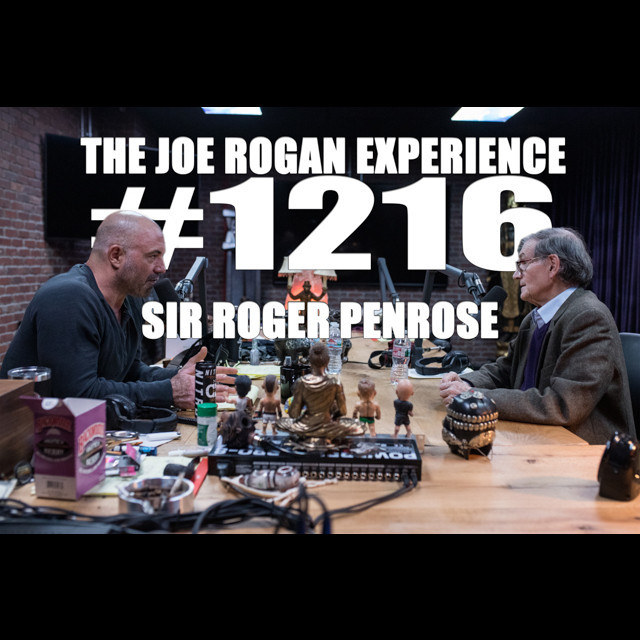
18-Dec-18
This podcast features a captivating conversation with Sir Roger Penrose, a renowned mathematical physicist, mathematician, and philosopher of science. Penrose delves into the fascinating and often perplexing world of consciousness, the nature of reality, and the mysteries of the universe. The dialogue explores profound questions that have puzzled thinkers for centuries, offering insightful perspectives on the limitations of computation, the role of quantum mechanics in consciousness, the possibility of multiple universes, and the mind-boggling scale of the cosmos.
Major Topics Explored:
- The Non-Computable Nature of Consciousness:
- Penrose argues that consciousness cannot be reduced to mere computation, suggesting that it involves a non-computable element that transcends algorithms.
- He draws inspiration from Gödel’s incompleteness theorem, which demonstrates the existence of mathematical truths that cannot be proven within any given formal system.
- Penrose posits that our understanding and conscious experience go beyond the ability of computers to simulate them, requiring a deeper level of comprehension.
- He highlights the limitations of current artificial intelligence, asserting that consciousness involves something fundamentally different from computation.
- The Role of Microtubules in Consciousness:
- Penrose explores the intriguing possibility that microtubules, protein structures within brain neurons, play a critical role in consciousness.
- He acknowledges the work of Stuart Hameroff, who has developed a theory suggesting that microtubules might support quantum processes essential for consciousness.
- Penrose emphasizes the importance of symmetry in microtubules, citing the Jan Teller effect in quantum mechanics, which suggests that highly symmetrical structures can shield quantum information.
- He proposes that these quantum effects within microtubules might contribute to the unique qualities of human consciousness.
- The Mystery of Measurement in Quantum Mechanics:
- Penrose highlights the perplexing nature of the measurement problem in quantum mechanics, where the act of observing a quantum system seems to collapse its wave function.
- He argues that this collapse is not adequately explained by current quantum theory and suggests that it might involve a non-computable element that lies beyond the realm of conventional physics.
- He distinguishes between the comprehensible aspects of quantum mechanics, such as entanglement, and the more mysterious aspects related to wave function collapse.
- Penrose believes that a deeper understanding of the measurement problem may hold key insights into the nature of consciousness and reality.
- The Existence of Black Holes and Singularities:
- Penrose delves into the history of the concept of black holes, tracing it back to the work of Chandrasekhar, Oppenheimer, and others.
- He explains his own contributions to the theory of black holes, including his proof of the existence of singularities within them.
- Penrose describes the nature of singularities as points where the equations of general relativity break down, indicating the presence of extreme gravitational fields.
- He discusses the various properties of black holes, including their mass, rotation, and the phenomenon of Hawking radiation.
- The Conformal Cyclic Cosmology (CCC) Model:
- Penrose presents his controversial Conformal Cyclic Cosmology (CCC) model, which proposes that the universe undergoes an infinite cycle of big bangs and expansions.
- He argues that the CCC model provides a solution to the “big bang singularity problem” and offers a mechanism for the creation of dark matter.
- Penrose suggests that Hawking radiation from black holes in the previous eon might manifest as observable “Hawking points” in the cosmic microwave background radiation.
- He discusses the potential for detecting these Hawking points as evidence for his CCC model, potentially revolutionizing our understanding of the universe’s origin and evolution.
- The Nature of Dark Matter and Dark Energy:
- Penrose explores the enigmatic nature of dark matter and dark energy, which account for a significant portion of the universe’s mass and energy density.
- He presents his own perspective on dark energy, suggesting that it might be a form of scalar particles that interact only gravitationally.
- Penrose connects his theory of dark energy to his CCC model, proposing that it is created during the transition from one eon to the next.
- He discusses the potential for detecting dark matter particles through gravitational waves, which could provide further support for his model.
- The Search for Extraterrestrial Intelligence (SETI):
- Penrose acknowledges the search for extraterrestrial intelligence (SETI) but expresses skepticism about the likelihood of detecting signals from advanced civilizations within our current eon.
- He suggests that the possibility of receiving signals from civilizations in previous eons, which might have survived in the form of photons, is more intriguing.
- Penrose highlights the challenges associated with detecting such signals and the vast timescale involved.
- He acknowledges the enduring fascination with the possibility of other intelligent life in the universe, but remains cautiously optimistic about its feasibility.
- The Importance of Non-Mainstream Research:
- Penrose emphasizes the value of pursuing non-mainstream research, even if it challenges conventional scientific paradigms.
- He discusses the establishment of the Penrose Institute, which aims to support research that explores unconventional and potentially groundbreaking ideas.
- Penrose highlights the importance of subjecting these ideas to rigorous scrutiny and experimental testing, ensuring that they are not merely speculative but grounded in empirical evidence.
- He believes that pushing the boundaries of scientific inquiry is essential for advancing our understanding of the universe and the nature of reality.
Memorable Quotes:
- “We don’t think when we understand something that what’s going on in our heads is not an algorithm. It’s not following rules. It’s something else. It’s something that requires our conscious appreciation of what we are thinking about.” – Penrose highlights the non-computable nature of human consciousness, arguing that our understanding transcends algorithms.
- “I don’t think it’s only in microtubules. I don’t know. I’m not sure what Stuart Hameroff’s view on this is. He certainly thinks the microtubules are seasonally important and consciousness. And I think he’s right. That’s the feeling I get. And he’s done a lot of work on trying to find what anesthetic acid is an important one of the important ways you can tell things about consciousness.” – Penrose acknowledges the role of microtubules in consciousness while emphasizing that other factors may be at play.
- “But you see I’ve been doing work on this kind of thing thinking more about gravitational radiation and how you measure its energy and things like that. And it was a very useful picture to squash down infinity a useful thing to think about here if you’ve seen these pictures by the Dutch artist, MC ESHA.” – Penrose connects his work on gravitational radiation to the concept of squashing down infinity, drawing a parallel to the artwork of MC Escher.
- “It’s not infinite mass. The mass is quite well defined, and it’s not infinite. But, yeah, always a good question. I mean, if you wait forever, how much of the mass actually gets swallowed by the Michael?” – Penrose clarifies that black holes have a defined mass, emphasizing that they are not infinitely massive, despite their immense gravitational pull.
- “It’s almost like, why bother with the womb? The beautiful reality is you make a very good point. It’s a woman in and of itself. You’re absolutely right. No. It’s very, very strange. It’s quantum mechanics. in so many ways is.” – Penrose acknowledges the bizarre and beautiful nature of reality, highlighting the mind-bending aspects of quantum mechanics.