11/17/2016
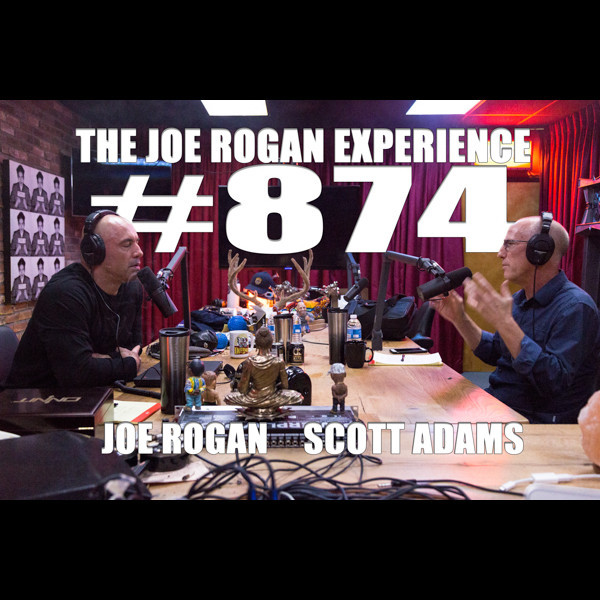
Joe Rogan Experience #874 – Scott Adams
This podcast features a captivating conversation between Joe Rogan and Scott Adams, creator of the Dilbert comic strip. The episode delves into a range of topics, from the intricacies of persuasion and the nature of human memory to the societal impact of the 2016 presidential election. Throughout the discussion, Adams shares his insights as a self-proclaimed “free thinker” and trained hypnotist, challenging conventional perspectives on politics, reality, and the human condition. Provocative and thought-provoking themes emerge, including the potential for a software simulation, the power of visual persuasion, and the complexities of human behavior in a polarized world.
1. A Humiliating News Radio Experience:
- Adams recounts an embarrassing encounter with Joe Rogan during a guest appearance on the sitcom “News Radio.”
- Adams, unfamiliar with acting, was supposed to deliver a line, but froze due to Rogan’s unexpected line delivery.
- This unexpected moment highlights Adams’s discomfort with the world of acting and his preference for more structured environments.
- The experience underscores the importance of a specific mental disposition and memory skills in live performances, especially in rapid-fire settings like sitcoms.
2. The Simulation Hypothesis:
- Adams proposes the simulation hypothesis, suggesting that our reality might be a software program.
- He posits that memories are flawed because the past doesn’t exist until we need it, a plausible explanation within the simulation framework.
- This concept challenges our understanding of reality and the nature of time.
- The simulation hypothesis leads to further contemplation about our existence and the possibility of multiple iterations of reality.
3. Scott Adams’s Freethinking Perspective:
- Adams describes himself as a “free thinker,” not aligning with traditional left or right political ideologies.
- He views political discourse through the lens of a hypnotist, recognizing the irrationality of human decision-making.
- Adams believes that people’s actions are primarily driven by fear, identity, and aspirations, while their justifications are often false.
- His perspective challenges the notion of objective rationality in political decision-making and highlights the influence of emotional factors.
4. Trump’s Persuasion Skills:
- Adams analyzes Donald Trump’s communication style, recognizing him as a highly persuasive figure, perhaps the most persuasive living human.
- He highlights Trump’s use of visual imagery, catchy slogans, and linguistic kill shots to capture the attention of his audience.
- Adams dissects Trump’s ability to exploit confirmation bias, manipulating audience perceptions through evocative language and nicknames.
- This analysis challenges traditional notions of political discourse, emphasizing the power of persuasive techniques over policy details.
5. The Public as Leader:
- Adams argues that social media has shifted the power dynamics in politics, with the public now holding more influence than traditional leaders.
- He believes that Trump’s presidency reflects a shift from electing a role model to hiring an employee with specific skills.
- Adams points to Trump’s receptiveness to public opinion and his willingness to adjust policies based on feedback, illustrating the power of social media in shaping political discourse.
- This discussion explores the evolving relationship between leaders and the public in the digital age, where information and opinion spread rapidly.
6. The Societal Bomb:
- Adams expresses concern over the societal bomb created by the 2016 election, a deep polarization fueled by fear and misinformation.
- He believes that Hillary Clinton’s campaign, through fear-mongering tactics, accidentally ignited a widespread sense of outrage and distrust that persists even after the election.
- Adams argues that the left’s perception of Trump as a fascist figure, while unfounded, has created a highly charged and potentially dangerous environment.
- This analysis highlights the fragility of societal stability and the dangers of unchecked fear-mongering in the political arena.
7. The “Hillary for Prison” Controversy:
- Adams discusses the “Hillary for Prison” hashtag and the possibility of Twitter shadow banning it, suggesting an attempt to silence dissenting voices.
- He points to the case of Milo Yiannopoulos, who was banned from Twitter for controversial comments, highlighting the arbitrary nature of censorship on the platform.
- Adams raises concerns about the potential for censorship and the power of large tech companies to control information flow.
- This discussion explores the intersection of free speech, social media, and political polarization.
8. The Shifting Landscape of Political Correctness:
- Adams argues that Trump’s presidency has significantly altered the landscape of political correctness, loosening the constraints on offensive language.
- He observes the increased use of previously taboo language, highlighting the president’s influence on social norms.
- Adams reflects on the pendulum swing of societal values, suggesting a backlash against excessive sensitivity and a return to a more open and less censored environment.
- This analysis explores the complexities of social change, the impact of leadership on cultural norms, and the delicate balance between free speech and social responsibility.
9. The Caitlyn Jenner Controversy:
- Adams expresses his skepticism towards the elevation of Caitlyn Jenner as a cultural icon, questioning the rationale behind celebrating her transition while overlooking her flaws.
- He points to Jenner’s involvement in a fatal car accident, a topic largely ignored during her media appearances, highlighting the selective focus on her gender identity over other aspects of her life.
- Adams argues for a more holistic approach to understanding individuals, moving beyond singular identities to acknowledge the full spectrum of their complexities.
- This discussion highlights the dangers of placing individuals on pedestals solely based on their identity and the importance of recognizing the full spectrum of human experience.
10. The Allure of Tribalism:
- Adams examines the human inclination towards tribalism, particularly evident in sports team fandom and political affiliations.
- He questions the rationale for intense emotional investment in sports teams, especially given the arbitrary nature of team compositions and the fleeting nature of player involvement.
- Adams suggests that the desire for belonging and group identification, potentially rooted in biological and evolutionary drives, fuels this phenomenon.
- This discussion explores the psychological underpinnings of tribalism and its impact on human behavior.
11. The Origins of Football:
- Adams discusses the origin of American football and its connection to the post-Civil War era, suggesting that it emerged as a substitute for war in satisfying the need for conflict and national unity.
- He references a Radiolab podcast that delves into the history of football and its development as a vehicle for testing character and fostering national pride.
- Adams explores the complex relationship between sport, society, and the psychology of conflict resolution.
- This analysis suggests that certain societal needs, such as the need for conflict, are often channeled into alternative forms, like sports, when other outlets, like war, are unavailable.
12. The Perils of Genocide and Native American History:
- Adams reflects on the largely ignored history of the genocide of Native Americans in the United States.
- He points to the lack of a unified symbol representing this conflict, unlike the Confederate flag, which evokes strong emotions on both sides.
- Adams challenges the notion of historical amnesia, emphasizing the importance of remembering and confronting our nation’s darker chapters.
- This discussion raises questions about societal memory, the ethics of historical representation, and the need to acknowledge the lasting impact of past injustices.
13. The Future of Humanity:
- Adams speculates on the future of humanity, envisioning a world where life expectancy surpasses 100 years and advanced technology allows for the digital reconstruction of deceased individuals.
- He discusses emerging technologies like Wvoca, a software program capable of manipulating audio in unprecedented ways, suggesting the potential for creating digital replicas of deceased individuals.
- Adams contemplates the implications of this technological advancement on our understanding of identity, consciousness, and mortality.
- This discussion explores the potential for technology to blur the lines between life and death, leading to profound ethical and philosophical questions.
14. The “Tech Accent” and Upspeak:
- Adams analyzes the “tech accent,” a distinctive mode of speech prevalent in Silicon Valley, characterized by upspeak and an unpredictable cadence.
- He suggests that this accent serves as a marker of social identity, signaling affiliation with the tech community.
- Adams points to the influence of social pressures on language and the ways in which we use speech to communicate our belonging and our values.
- This discussion explores the evolving role of language in a technologically driven world, highlighting the intersection of communication, identity, and social trends.
15. The Dangers of Unchecked Emotion:
- Adams argues that emotion often overrides logic and data in human decision-making, particularly in politically charged contexts.
- He highlights the difficulty of persuading people with facts when their emotions are deeply invested in a particular viewpoint.
- Adams cautions against the dangers of unchecked emotion and the potential for it to fuel conflict and misinformation.
- This analysis underscores the need for critical thinking, rational discourse, and a balanced approach to navigating emotionally charged issues.
16. The Role of the Vice President:
- Adams speculates on the potential impact of Mike Pence as Vice President, suggesting that he will likely adopt Trump’s policies to gain greater public acceptance.
- He observes that Pence is a skilled communicator and debater, highlighting his potential for future political ambitions.
- Adams raises concerns about Pence’s history on gay rights issues, but acknowledges that his public persona may evolve as he adapts to the political landscape.
- This analysis explores the dynamics of power, political ambition, and the potential for individuals to shift their positions in response to societal pressures.
17. The Erosion of Privacy:
- Adams believes that the erosion of privacy is an inevitable consequence of technological advancement, leading to a future where everything we do is tracked and recorded.
- He suggests that this loss of privacy, while potentially alarming, could also lead to a more transparent and accountable society.
- Adams contemplates the ethical implications of this trend, questioning the value of privacy in a world where information is readily available.
- This discussion explores the complex relationship between technology, society, and the evolving definition of privacy.
18. The Collective Brain of the Internet:
- Adams sees the internet as a burgeoning collective brain, capable of generating new ideas and insights through its real-time communication and information sharing.
- He cites the use of Periscope, a live streaming platform, as an example of how the collective intelligence of the internet can augment and amplify individual thought.
- Adams envisions a future where government and decision-making are influenced by this collective intelligence, potentially shaping a more participatory and transparent political system.
- This analysis explores the potential of technology to democratize information, foster collaboration, and redefine the nature of decision-making in a globalized world.
19. The Perils of Unrealistic Expectations:
- Adams critiques the tendency to hold unrealistic expectations of political leaders, pointing to historical figures like JFK and Bill Clinton as examples of complex individuals whose flaws were often obscured by their public personas.
- He argues that the constant scrutiny and dissection of public figures’ lives often leads to distorted perceptions and the creation of unrealistic expectations for perfection.
- Adams emphasizes the need for a more nuanced and forgiving approach to understanding political leaders, acknowledging that even the most admired individuals have their own imperfections.
- This discussion challenges the myth of the perfect leader and encourages a more realistic and forgiving approach to evaluating political figures.
20. The Importance of Context and Nuance:
- Adams stresses the importance of understanding context and nuance in evaluating individuals and their actions.
- He cautions against drawing definitive judgments based on isolated events or out-of-context statements.
- Adams emphasizes that human beings are complex, ever-evolving creatures, and judging them solely based on past actions ignores the potential for growth and transformation.
- This discussion highlights the dangers of oversimplification in human judgment and encourages a more compassionate and nuanced understanding of individual behavior.
5 Memorable Quotes:
- “I am a proponent of the we are all a software simulation view of reality, and that would also explain why memories are so screwed up.” – Adams’s perspective on the simulation hypothesis and its implications for human memory.
- “The real reasons that people make decisions are fear, identity. You know, they have some aspiration. They’ve they’ve got something they’re trying to solve. There’s something they’re trying to work out. but the reasons we give are usually completely false.” – Adams’s insight into the hidden motivations behind human behavior.
- “He always goes for the visual. because we know that the the visual part of our brain is the dominant part. And if you can get its attention and get it on your message, it talks the rest of your brain into anything you wanted to.” – Adams’s explanation of Trump’s use of visual persuasion.
- “You only get a few of those in your life.” – Adams reflects on the thrill of witnessing a prediction come true, referencing his prediction of Trump’s victory.
- “It’s like, you know, picking a lawyer. I don’t I don’t care what he’s doing in his personal life. He’s not my role model.” – Adams’s perspective on the evolving relationship between the public and political leaders.